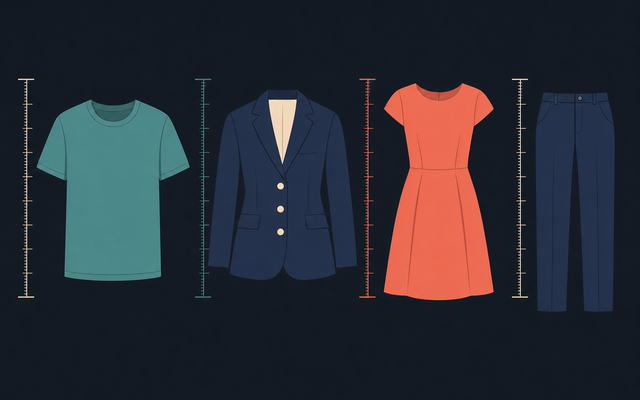
US, UK, AU, EU, and Japan
Choose a clothing group, source system, and known label to see approximate international equivalents and a reference body measurement.
How international clothing size conversion works
Limitations summary
- No universal conversion exists: brands choose their own blocks, fit models, grading rules, and label ranges.
- Letter sizes cover ranges: S, M, L, and XL can span more than one numbered size and mean different measurements between brands.
- Garment types differ: this table covers general clothing and broad adult pants/trousers equivalents—not bras, precise denim fits, tailoring specifications, hats, gloves, or specialist wear.
- Measurements are approximate: bust, chest, and height ranges describe bodies, not the dimensions of a finished garment.
- Pants/trousers length is separate: the adult pants/trousers rows compare waist-based sizes only; they do not convert inseam, rise, leg shape, or short/regular/long lengths.
- Fit preference matters: slim, regular, relaxed, oversized, stretch, maternity, petite, tall, and plus-size ranges cannot be reduced to one equivalent label.
Why clothing sizes vary internationally
A clothing size is a label assigned to a range of body measurements, not a physical unit like a centimetre or inch. National traditions developed different number sequences, while individual manufacturers adapted those sequences for their customers. A women’s US 8, UK/AU 12, and EU 40 are often placed on the same comparison row, but that does not make the garments identical.
Differences begin before fabric is cut. Designers use a base pattern or “block,” choose a fit model, add wearing ease, and grade the pattern up and down. One brand may design a medium for a 92–95 cm bust; another may use a different range or deliberately create a loose silhouette. Vanity sizing and changes to a brand’s customer profile can also shift labels over time.
What this converter compares
The women’s general table compares dress and top labels using bust ranges. The men’s general table is aimed at tops, shirts, knitwear, outerwear, and jacket-style chest labels. Separate women’s and men’s pants/trousers categories use approximate waist ranges, with hip ranges also shown for women. The children’s table remains for general clothing only and uses age bands and height; it does not include children’s pants/trousers conversions.
International letter labels group several numbered sizes together. For example, a women’s medium in this table spans roughly US 8–10, UK/AU 12–14, and EU 40–42. That wide grouping is intentional. It reflects the fact that an “M” cannot honestly be represented by one exact national number across all retailers.
How to take body measurements
- Use a flexible tape measure over light clothing or underwear, without pulling the tape tight.
- For bust or chest, pass the tape around the fullest part, level across the back, while breathing normally.
- For waist, measure the natural crease of the torso rather than relying on where a particular pair of trousers sits.
- For hips, measure around the fullest part of the seat with feet together.
- For children, measure standing height without shoes and use age only as a secondary clue.
Repeat any surprising measurement and record it in centimetres and inches if the retailer offers both. If bust, waist, and hip measurements point to different sizes, prioritise the dimension that controls the garment. A fitted dress may be governed by bust and hip; a loose top may depend mostly on bust; trousers need a separate waist-and-hip chart.
Worked examples
A women’s US 8–10 maps broadly to UK/AU 12–14, EU 40–42, Japan 11–13, and international M in this table, with a reference bust of about 92–99 cm. Treat the range as a shortlist, then compare the retailer’s bust, waist, and hip measurements.
A men’s US/UK jacket 40 is commonly near EU 50. Because medium covers more than one chest label, this converter groups US/UK 38–40 and EU 48–50 under M. A fitted suit still needs direct chest, shoulder, sleeve, drop, and alteration guidance from the maker or tailor.
For pants/trousers, a women’s US 8–10 is broadly comparable to UK/AU 12–14 and EU 40–42, while men’s W32–34 is commonly near EU 48–50. These comparisons estimate waist categories only; the required inseam and preferred rise or leg cut must be selected separately.
Women’s and men’s labels are not interchangeable
Women’s numbered sizes usually represent a graded body-measurement range. Men’s tailored jacket numbers often resemble chest measurements in inches, although the actual body and finished-garment specifications still vary. “Unisex” does not solve the problem: it often starts from a men’s or neutral block, so a wearer may choose a different letter than in a women’s fitted range.
Children’s clothing needs regular remeasurement
Age labels assume an average growth pattern and can be misleading for a taller, shorter, broader, or slimmer child. EU and Japanese children’s labels often relate more closely to height in centimetres, but brands still allow different room for movement and growth. Use current height, chest, waist, and the product chart. Avoid adding so much growing room that cuffs, hems, or loose fabric create a safety or mobility problem.
Garments that need their own chart
The pants/trousers converter provides broad waist-based equivalents, but jeans and tailored trousers still need the maker’s waist, hip, rise, thigh, inseam, and leg-shape chart. Bras require band and cup measurements. Tailored shirts may use collar and sleeve length. Suits can use chest size plus a drop and short, regular, or long proportions. Compression wear, protective equipment, swimwear, cycling kit, and medical garments are especially sensitive to fit and should never be selected from a general conversion alone.
Common mistakes
- Assuming UK and US women’s numbers are the same because both use even numbers.
- Converting only the label instead of checking the body-measurement row.
- Measuring a favourite garment and comparing it directly with a body-size chart.
- Ignoring fabric stretch, lining, layering, and the garment’s intended silhouette.
- Treating a pants/trousers waist conversion as an inseam or rise conversion.
- Using a child’s age without checking current height and chest.
FAQs
- Should I choose the larger size when between rows?
- It is often the safer starting point for non-stretch fitted garments, but the controlling body measurement, intended fit, fabric, and brand advice matter more than a general rule.
- Are UK and Australian clothing sizes the same?
- Women’s numbered labels are commonly aligned closely enough for a shared comparison column. Brand-specific differences remain, and men’s casual labels may use letters rather than regional numbers.
- Why are some outputs ranges?
- Letter sizes usually cover several numbered sizes. Showing a range is more honest than inventing a precise one-to-one match.
- Can this converter replace trying clothes on?
- No. It narrows the likely range when shopping internationally; it cannot predict fabric behaviour, proportions, comfort, or personal fit preference.
Using the result responsibly
Use the converted row to identify one or two likely sizes, then open the product’s own size guide. Check whether that guide lists body measurements or finished-garment measurements and do not mix the two. Read reviews for consistent comments about running small, large, short, or narrow, and check the returns policy before ordering from another country.
Last updated: July 2026